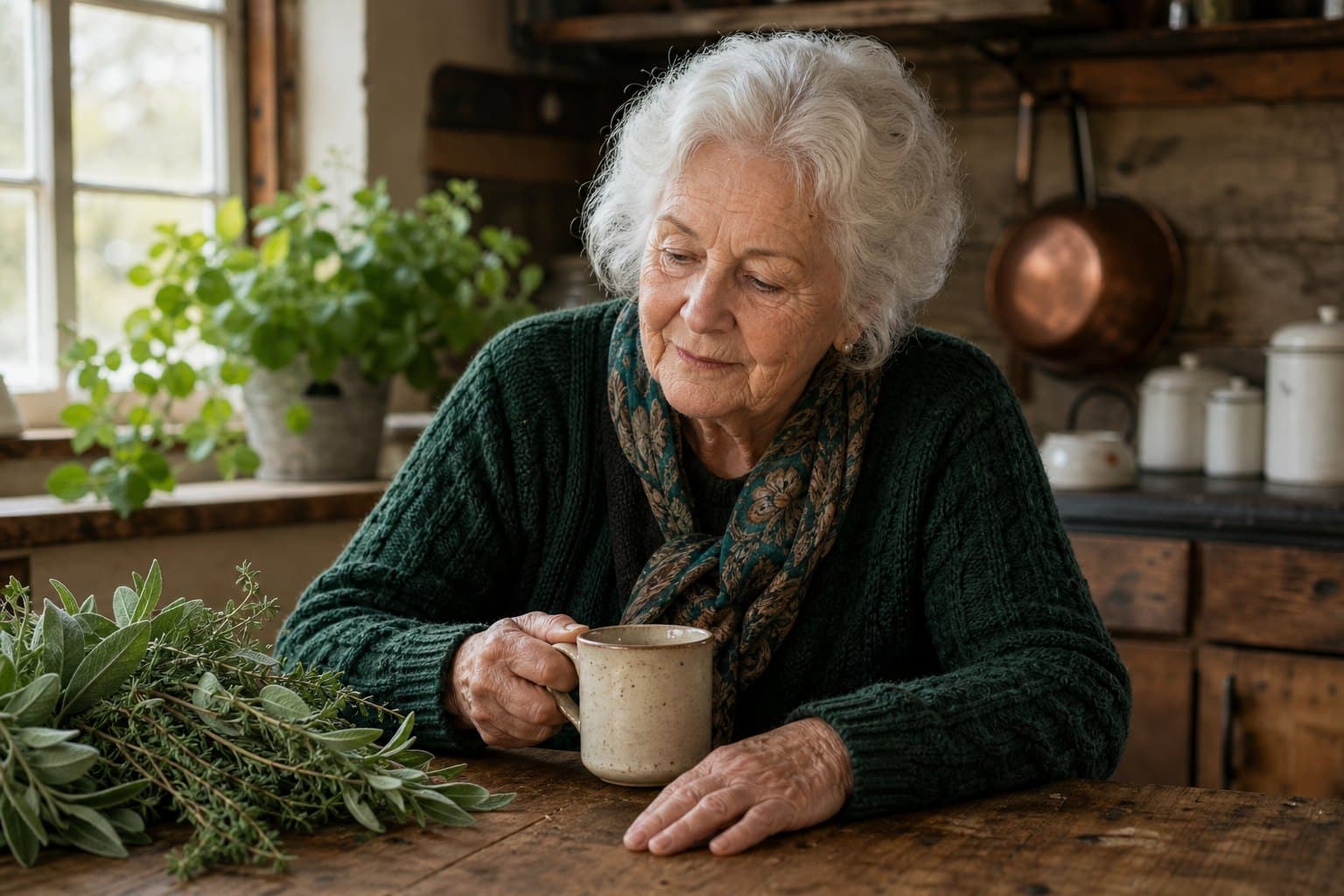
She says she does not want anything. You believe her, mostly. She has scarves. She has candles she did not light. Another photo frame will sit in the same cupboard as the last one. You still want something that is not wrapping paper. The useful gift is a conversation you can keep.
Quick answers
What do you get Nan when she already has everything?
One conversation you can keep, not another candle. Twenty minutes, one or two scenes, her words stored somewhere you can find in five years.
How do you ask Nan for stories if she hates being interviewed?
Do not sit her opposite a phone. Ask about a kitchen that was hers, a street that is not there now, the first time she noticed Grandad. Record only if she says yes in words. She can pause, skip, or stop.
How long does it need to take?
About 30 minutes all in: ten minutes to pick three questions and tell her the plan, twenty minutes on the day, then ten minutes to label what you kept. Stop while she is still going.
The stall
You have meant to do this for years. Not in a dramatic way. In the way you mean to drop in on a Sunday and then the afternoon gets away. A birthday will come around. Christmas will come around. She will still say she does not want anything. The stall is not laziness. It is the feeling that a proper job of her life would take a year, a recorder you do not own, and a sit-down she will hate. That job is not this job.
Why objects fail
A scarf is a guess about colour and a guess about whether she already has three. A candle is a smell she did not choose. Another photo frame is a shelf she will clear for it and then forget. A tote is a handle she will fold into a drawer. Objects fail because they try to stand in for attention, and she can feel the substitution. She has everything because people have been substituting for years. The cupboard of unused lotion is not a joke. It is a record of love that did not know where to land.
What actually lands
What lands is a scene she has not had to tell before, kept in her words, somewhere you can find when you want it. Not a memoir. Not a performance. Twenty minutes in which you ask about the first kitchen that was hers, or the back door everyone used, and you let the answer be shorter than you hoped. You keep it. That is the whole gift.
A 30-minute plan
Before
Pick three questions. Tell her the plan in one sentence: you want to hear one story, it will take about twenty minutes, and she can stop whenever. Do not send a questionnaire.
On the day
Stand in the kitchen, walk around the block, or sit in the car before you go in. Ask about the thing in front of her, or a place that is not there now. Record only if she says yes in words. Stop while she is still going.
After
Label what you kept: whose voice, which day, which question. Put the file or the notebook page where next year you will find it. Ten minutes. Then leave it alone.
Fourteen questions that are not “tell me about your childhood”
- What was the first kitchen that was yours, not your mother's? What always sat next to the sink?
- Is there a street you grew up on that is not there now? What did a Tuesday evening sound like on it?
- Where were you the first time you properly noticed Grandad, and what was he doing?
- Who came through the back door without knocking, and what did they bring?
- What was on the wireless when you got home from work or from the shops, and who changed the station?
- If you could stand in a doorway that is gone, which one, and what would you expect to hear on the other side?
- What did your first proper pay packet go on?
- A neighbour you could hear through the wall. What did their evenings sound like?
- The first night you were home with a baby and everyone else had gone. What was on: the kettle, the street, the wireless?
- What did knock-off smell like: the bus, the shop floor, the bag you carried?
- Who made you laugh before any of us were around, and what did they sound like when they did?
- A place you still pass that looks ordinary to everyone else. What do you see there?
- A hard year you got through. You do not have to name it if you do not want to. What got you to the next morning?
- A place you still pass that looks ordinary to everyone else. What do you see there that they do not?
Ask the harder ones once. If she declines, move on and do not return to them.
If you want the longer list, there are questions to ask your grandmother. If this is Grandad, there are questions to ask grandfather. If you mean both grandparents, there are questions to ask grandparents. If the present is for Grandad, use what to get Grandad when he already has everything.
Planning for Grandparents Day?
Yarn, not a sit-down
A chair and a phone between you is an interview. She will give you the official version. Keep her hands busy: kettle, washing, steering wheel. You are beside her, not opposite. Ask about the thing she is holding, or the street that used to be there. If the answer goes somewhere unexpected, follow it. If it does not, that is still a story.
Tools you can use
A notebook is enough. Voice Memos on a phone is enough, if she says yes. Weekly-question memoir services will email her a prompt and, if she keeps going, bind the year into a hardcover. That is a known path. It asks for a writing habit. Phone memoir books that turn several calls into a keepsake are another known path. They ask for more than one sitting. A voice session that becomes a card is the short version: talk once, keep a page you can read back.
If this is a present for Mum rather than Nan, there is what to get Mum when she already has everything. For parents in general, story gifts for parents who have everything and the voice memoir gift sit next to this page. If you are recording by phone, there is a guide to record a parent's story by phone.
Tellby's early family pilot is one relaxed 10 to 15 minute conversation that becomes a private written-and-audio story card. They can pause, skip, or stop during the conversation. You read the memory card and approve it before the rest of the family sees it. Applying does not enrol or consent for Nan (or your parent or relative). How Tellby works with someone's voice is the public page for those controls.