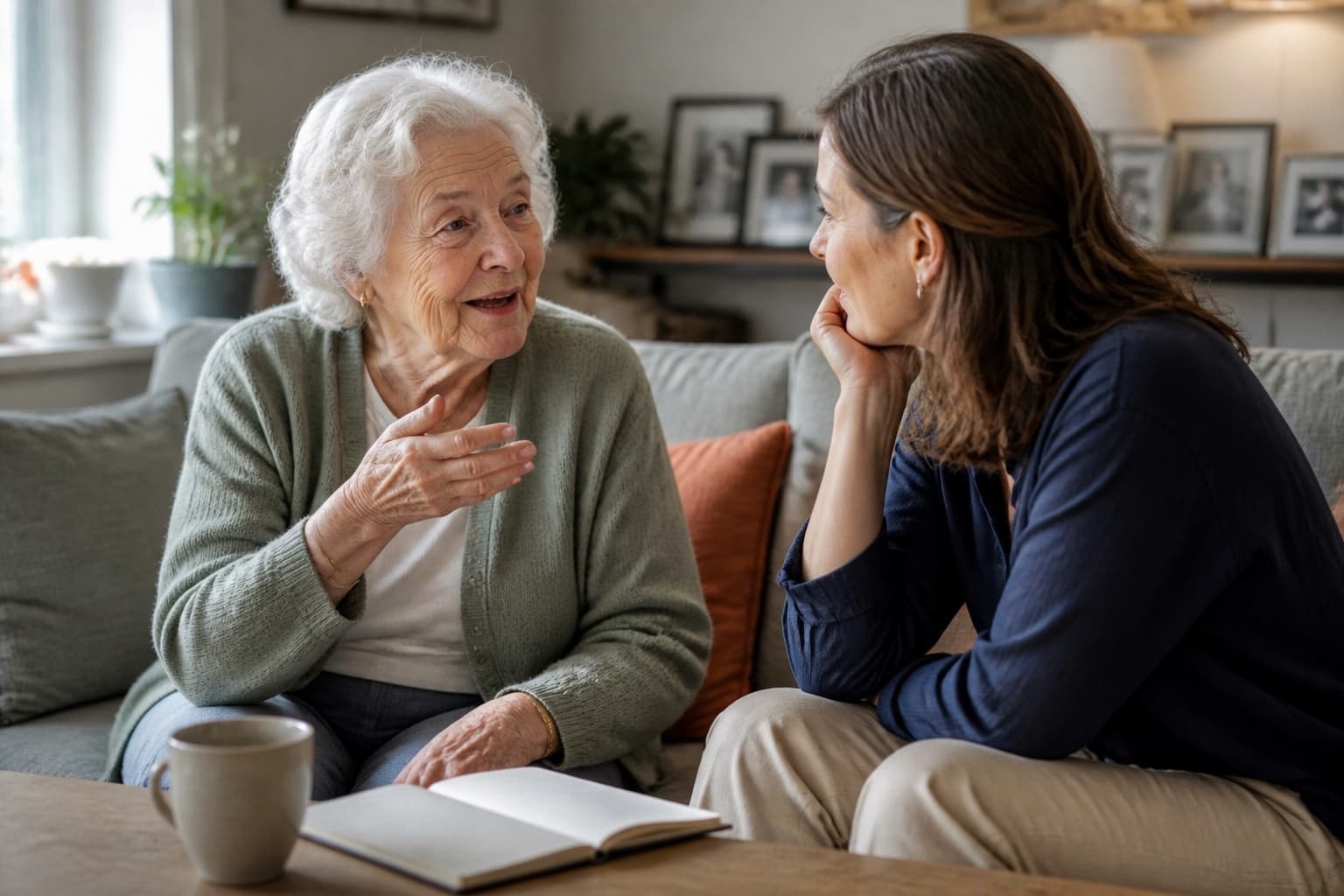
Whether she is Grandma, Nan or Nana to you, do not open with "Tell me about your life." It is too big to answer, so you are likely to hear the polished version. Small, specific questions invite the textures, places and feelings that make a memory sound like her.
What questions should I ask my grandmother or Nan to record her life story?
Ask questions that contain a place, a person, a moment or a sense: the first kitchen she remembers, how her mother sounded when she was cross, what a Monday morning felt like at her first job. Choose five to ten from the list below. A good follow-up is more valuable than reaching the end.
Her childhood home
- What's the first kitchen you remember? What did it smell like when something was cooking?
- Where did you sleep as a child, and who did you share a room with?
- What was the street like outside your front door? Which neighbour do you remember best, and why?
- What did a normal weekday look like, from waking up to going to bed?
- What did your family have that other families didn't? Or what did they have that you didn't?
The people who raised her
- What did your mother sound like when she was pleased with you? What about when she was cross?
- What's one thing your father did that you can still see clearly, like a photograph?
- Who was the funniest person in your family when you were young? What made them funny?
- Who was the strictest? What happened if you broke their rules?
- What did your grandparents call you, and what did you call them?
Firsts: the ones that made her who she is
- What was your first day of school like? Who walked you there?
- What was the first thing you ever earned money for, and what did you do with it?
- How old were you the first time you left your hometown, and where did you go?
- What was the first record, song or film that felt like it belonged to your generation, not your parents'?
- What did you want to be when you grew up? And what did that version of you think your life would look like?
Work, money and the world
- What was your first job, and what did the place feel like on a Monday morning?
- What did a week's wages buy in those days? What did you spend yours on?
- What was happening in the world when you were twenty, and did it feel like it mattered to you then?
- Was there ever a time money was genuinely tight? What did your family do about it?
- What's a piece of advice you were given about work or money that turned out to be completely wrong?
Love and family
- How did you meet Grandad? Take me through the actual day, not the short version.
- What did you first think of him, honestly?
- What did your wedding day feel like, not look like? What went wrong?
- What surprised you most about having children?
- What's a moment with your children that you've never told anyone about?
The hard parts, offered and never pushed
- What was the hardest year of your life, and how did you get through it?
- Was there a goodbye you wish you'd done differently?
- What's something you were afraid of for years that eventually turned out fine?
Ask these gently, once, and accept a short answer. You can offer, "I would listen if you wanted to tell me more." If she declines, move on and do not return to it.
Then and now
- When you were my age, what did you think your life would be like by now?
- What's something you believed strongly at thirty that you've changed your mind about?
- What do you know now that you wish someone had told you at twenty?
- What are you proudest of that has nothing to do with work?
Memory and legacy
- What's the oldest memory you have? How old are you in it?
- Which family story do you think I should know that nobody tells any more?
- What did your own grandmother tell you that you've carried all your life?
- Is there anything in the family's past you were told, rather than saw yourself? What did they tell you?
- What's something about our family that isn't written down anywhere and lives only in you?
- What do you hope your great-grandchildren know about you?
- What's one thing you've never been asked that you wish someone would ask?
- If we record again next month, what would you like to talk about?
How to ask: three simple rules
One question, then silence. After she answers, wait. The second wave of an answer is often more detailed than the first.
Ask for the senses, not the summary. "What did it smell like?" and "What did she sound like?" can unlock memories that "What was it like?" does not.
Separate witnessed from heard. When she tells you something from before her time, gently ask: "Did you see that yourself, or did someone tell you?" A family record is more useful when it keeps that distinction.
Do not turn the conversation into a fact check. If a date seems wrong or two memories disagree, keep the storyteller's words and make room for later context rather than correcting her in the moment.
Before you begin, read the simple setup in how to record your parent's voice and stories. If this conversation is a present, our guide to story gifts for parents who have everything explains how to offer it without making it feel like homework. If this is a present for Nan, there is a gift guide for when she already has everything.
Stay here if you want Nan's stories. If you want Mum's, there is a separate guide for questions to ask Mum. If you mean both grandparents, there is a shared starter set.
Frequently asked questions
How many questions should I ask in one sitting?
Five to ten. A recording session is a conversation, not a questionnaire. Ten answered questions with natural follow-ups are more valuable than forty read aloud. Save the rest for another visit.
My grandmother keeps giving short answers. What am I doing wrong?
Try replacing a broad question such as "Tell me about your childhood" with a small question that contains a scene: "What did Saturday morning look like when you were ten?" Short answers can also mean the subject is tender. Offer once to listen, then move on if she does not want to continue.
Do these questions work for Nan or Nana?
Yes. Grandma, Nan, Nana or Gran, the questions are the same. Use the name she answers to, and swap in your own family's words where a question names someone, such as Grandad or Pop.
Should I write the questions down for her in advance?
Share the topic in advance if that helps her feel comfortable, but consider keeping the exact questions flexible. That leaves room for an unguarded answer while respecting anyone who prefers time to think or needs information in advance to participate comfortably.
What recording setup do I need?
A phone or tablet on the table between you is enough. Use its built-in recorder, reduce interruptions, make a short test clip and keep the first session to about 10 to 15 minutes.